The Challenge: The Saltwater Marine Microclimate
Ocean freight cargo passing through the Indian Ocean, Arabian Sea, Suez Canal, and equatorial shipping routes is exposed to violent thermal swings. Daily temperature cycling inside cargo holds and shipping containers causes the ambient air to repeatedly cross its dew point — a phenomenon known in marine logistics as 'container sweat' or 'cargo rain'.
For unpainted machined surfaces, CNC spindle components, polished shafts, hydraulic cylinders, and electrical switchgear, bare sea air containing sodium chloride particles causes rapid electrolytic corrosion within 48 to 72 hours of exposure.
Aluminum Foil Vacuum Encapsulation: The Physical Hermetic Barrier
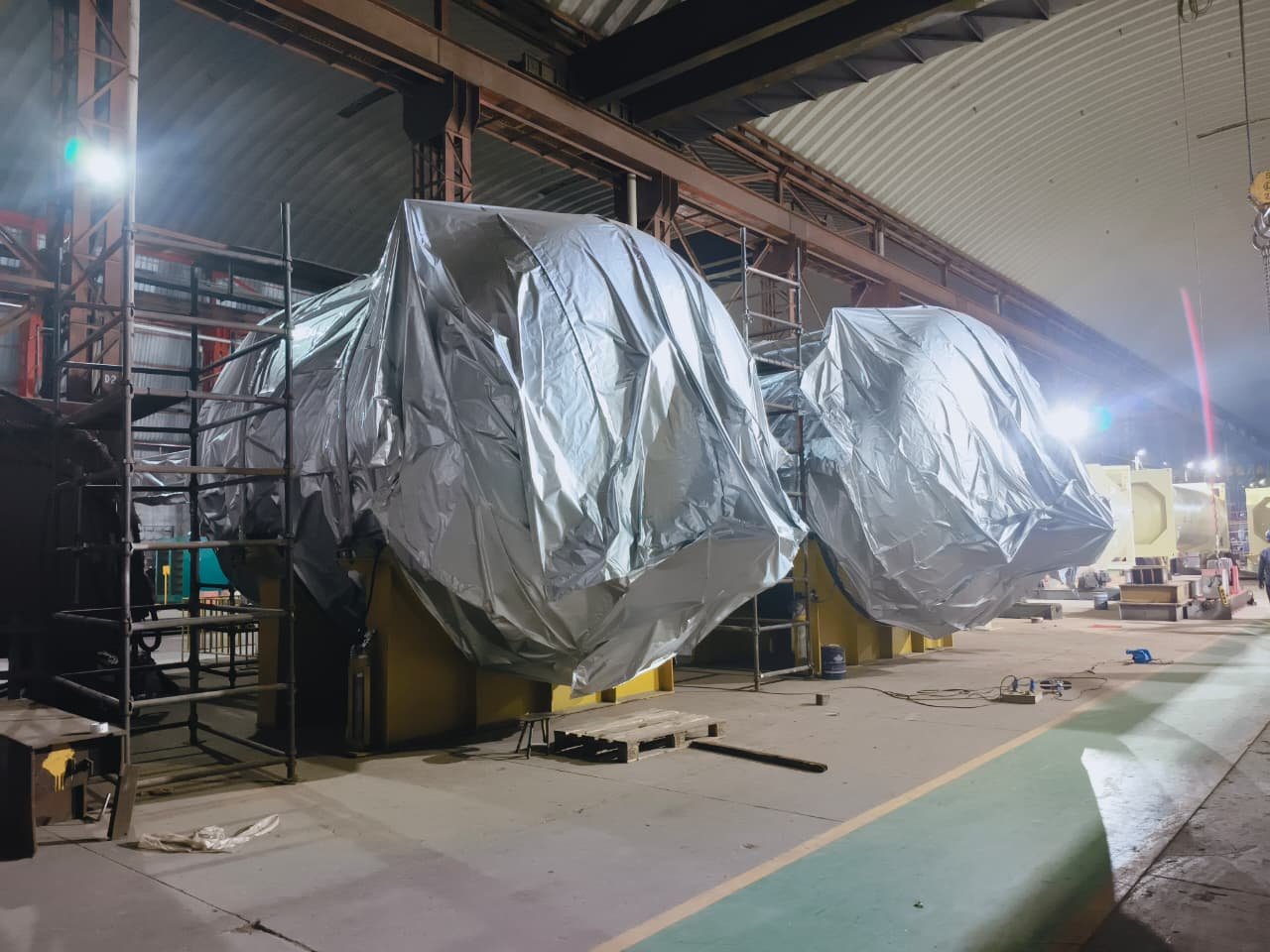
Hermetic Aluminum Barrier Foil Packaging (MIL-PRF-131 Class 1 specification) operates on the principle of complete physical exclusion. The packaging envelope consists of a multi-layer laminate:
- Outer Layer (Polyester / PET): High puncture resistance, mechanical tensile strength, and heat stability.
- Core Layer (Pure Aluminum Foil): Near-zero Water Vapor Transmission Rate (WVTR < 0.05 g/m²/24h) and zero oxygen ingress.
- Inner Layer (Polyethylene / LDPE): Heavy heat-sealable layer allowing airtight hermetic weld seams.
Once the machine is mounted on its skid, the foil envelope is fitted, precisely calculated quantities of non-dusting clay desiccants (DIN 55473) are suspended inside, ambient air is evacuated using high-capacity industrial vacuum extractors, and the barrier is heat-sealed. The enclosed equipment remains dry and inert for 12 to 36 months.
VCI (Volatile Corrosion Inhibitor) Wrapping: Active Molecular Shielding
VCI Packaging does not attempt to create a perfect vacuum seal. Instead, it utilizes high-molecular-weight organic amine salts impregnated into polyethylene film. Inside an enclosed space:
- The chemical salts vaporize into the surrounding micro-atmosphere.
- The vapor molecules naturally migrate to all polar metal surfaces (ferrous, copper, aluminum alloys).
- A monomolecular protective layer (1 to 2 molecules thick) forms over every micron of exposed metal, passivating surface charge and blocking galvanic oxidation.
- When the equipment arrives at destination and the wrap is cut open, the vapor dissipates instantly into the air, leaving the machine clean, dry, and immediately ready for commissioning with zero degreasing required.
Technical Comparison: Which Method Should You Specify?
| Criterion | Aluminum Vacuum Barrier Foil | VCI Heavy-Gauge Shrink Film |
|---|---|---|
| Moisture Barrier (WVTR) | Absolute barrier (< 0.05 g/m²/day) | Breathable / Permeable (1.5–3.0 g/m²/day) |
| Corrosion Mechanism | Zero humidity & zero oxygen environment | Active chemical molecular passivation |
| Best Use Case | Long ocean voyages (> 30 days), breakbulk, marine deck cargo | On-site plant turns, enclosed container shipping, yard storage |
| Surface Preparation | Requires desiccants (DIN 55473) | Direct wrapping; zero oily grease required |
| Protection Lifespan | 12 to 36 months (continuous sealed) | 6 to 24 months (intact enclosure) |
Frequently Asked Technical Questions
Common engineering and customs clearance questions answered by our Ranoli packaging desk.
How is the required desiccant quantity calculated for vacuum packaging?
We calculate desiccant units based on DIN 55473 and MIL-P-116 standard formulas, accounting for the total surface area of the foil envelope, the expected voyage duration (in months), the volume of hygroscopic packing materials (timber/paper cushions), and ambient humidity factors.
Can VCI and Aluminum Foil be combined for critical assets?
Yes. For mission-critical turbines, aerospace equipment, and offshore skids traveling across multi-month transit routes, our engineers frequently specify a dual-layer system: internal VCI emitter pouches or wrap directly on polished metal, enclosed inside a heat-sealed aluminum foil vacuum envelope.
Engineering Compliance Guarantee
All timber packaging, steel frames, and vacuum hermetic seals manufactured by Pankaj Packaging Services adhere strictly to international standards including ISPM-15, DIN 55473, and IS 2062 Grade A structural fabrication. Traceable treatment records are supplied with all dispatches.